
Course handbook

Parenting as a Church Leader

A print-ready handbook containing the printable notes in this course.

Opens a print-ready document in a new tab. Use your browser’s controls to print or save a copy.

Connected

The Importance of Connection

Discover why strong parent–child connection is essential for church leader families, and how it becomes the foundation for helping children thrive in ministry life.

Introduction

While there are many blessings of being a church leader family, you can also fear that, because of your vocation, your children’s faith will be damaged and they may turn away from God.

It is true that your children will be impacted and shaped by your vocation (just as all children are impacted and shaped by their parents’ lives). Your job, therefore, is to help your children navigate the difficult bits well and help them go on their own adventure with God, so that your family doesn’t just survive, but thrive!

We’ll be looking at how to do this well under four headings:

  • Connected (this session)
  • Prioritised (session 2)
  • Covered (session 3)
  • Empowered (session 4)

Your children need to feel fully connected to you. Think about a novice skydiver on their first flight in tandem with an experienced instructor. The thing that makes the novice feel safe is knowing that they are tightly and fully connected to the instructor, because he knows how to make everything work properly – then the novice can relax and enjoy the adventure.

As church leaders you are on the great adventure of ministry and your children come with you. What will help them get through the adventure well is a strong connection with you. You therefore need to figure out what helps your children feel connected to you so you can help them flourish even through tough stuff.

The problem of the hat dance

You can feel like you have two hats: a church leader hat and a parent hat. The problem is that in ministry, the two roles often seem to coincide. You can struggle to know which hat you are wearing at particular time; you and your family can feel the stress of trying to wear the right hat at the right time. You can feel like you are being pulled in opposite directions. But actually, you aren’t two different people: you are one person whom God has called to both ministry and parenthood.
Connected

How to Build Connection

Practical tools to build and maintain connection with your children—at home, at church, and even in the busiest ministry moments.

Connection is more than just affection or being present. You need to proactively build connection, just like you do already with your friends.

Develop a language of connection

One of the most powerful things you can do is to build a language of connection with your children so that they can recognise and name when they feel disconnected from you. Discover what language works for you and once they have that language you can use it to problem-solve how they are feeling.

Growing connection in the midst of ministry

Your children need to know they are connected to you everywhere you are together – at home or at church. You can help your kids learn how to access connection with you in the midst of ministry, and you can learn how to grow connection with your kids right in the middle of the busiest service. The aim is to create a steady flow of connection so your kids never stop feeling connected to you, even when you are busy with your job.

Gary Chapman’s love languages

Identifying which love languages your children have helps you to proactively build connection with each one separately. As they grow and change, you can adapt, so that you know that in the midst of your ministry you can always connect with them.

Ideas for quality time

Ideas for words of affirmation

Ideas for touch

Ideas for acts of service

Ideas for gifts

Connected

Coaching Children Through the Complexity of Church

Learn two key Parenting for Faith tools to help your children navigate church life, conflict, expectations and the “goldfish bowl” of ministry.

Church can be hard and complicated and our children need help in navigating this. When you have built a steady stream of connection with your children, it means that you can coach them through the tricky sides of church well.

There are two tools you can use to help you coach children through the tricky areas of church.

Creating Windows

Creating a window into how you deal with the big complicated bits of church – and who God is in that – helps your children to understand the heart of what’s going on and to see how they can manage it themselves.

Framing

By explaining what they are looking at, you can create a framework so they can understand everything well – whether it’s why people go to traditional services or why someone got upset with you. Research suggests that the primary cause of church leaders’ children walking away from faith and the church is that no one talked about church conflict; if children don’t have a place to understand and process church conflict, they won’t know how to understand it or cope with it.

Family stress and hypocrisy

Sometimes, the pressure of the church hat can mean that your kids see you performing differently for the church congregation – one minute you are scolding them, the next you have a big smile on your face, welcoming everyone. If this isn’t framed for your children, they may misinterpret this as meaning that they have to perform for the church or that you are hypocritical.

Find out more

Prioritised

Removing the Competition of Needs

Help your children feel valued and secure by removing the sense that they must compete with church for your time and attention.

The second thing our children need to flourish is that they need to feel prioritised: valued, important, and safe and secure in your affection and love.

In church leaders’ families, children can feel wobbly because they perceive a ‘competition of needs’. The needs of the church for their parent’s time and attention may seem so big in comparison with their needs that they internalise that as the need to compete for your time and attention.

Three ideas to help remove the competition of needs:

Language matters

It’s possible to unwittingly reinforce the competition of needs by the way you talk about your ministry. Shifting to ‘it’s a work thing’ helps to emphasise your disappointment and reinforce your desire for connection with your child, so they can see that their priority in your life is still strong.

Communicate the yes

Communicate where they do have permissions to do things, rather than where they don’t.

Choose to be a parent

Give yourself permission to be a parent while you are leading! Children need us to be a parent at all times, and there are times when you will need to be a parent in the midst of ministry. Work to create a culture in your church, your leadership and your teams where you are for each other’s families.

Prioritised

Tuning In: Making Your Presence Count

Learn how to help your children feel prioritised through attention, presence and predictable rhythms — even with an unpredictable schedule.

Children value your availability and attention more than the time you spend with them. If you can be fully present when you are with them, it makes a huge difference to them.

The stress of flexibility

While being a church leader can mean you have the flexibility to adjust your schedule to turn up at school or take a child out for lunch, children can find the unpredictability of this stressful.

Two ways to reduce the stress of flexibility:

Make a calendar

When children can see and understand their parents’ schedule, a lot of the stress of flexibility is removed.

Be faithful

When you are faithful to the schedule, to the arrangements you have made with your children, it reinforces their priority in your life.

Be fully present

Your schedule might allow you to watch a movie with your kids in the afternoon, but they want you to be fully present, your mind and attention as well as your body.

Three ways to be fully present:

  1. Don’t multitask
  2. Use bridging activities
  3. Ditch the phone

Find out more

Prioritised

Working From Home

Practical ways to create healthy boundaries at home so children feel secure, connected and prioritised — even when you’re behind a closed door.

Working from home is hard! By creating good boundaries and structures your children can still feel connected to you and prioritised by you, even when you are unreachable just beyond the door.

Be clear about when you’re working and when you’re not

When you are clear about when you are working and when you’re not, it removes the uncertainty for children. You may need to be creative in how you do this, using schedules, signs, timers or lists.

Use your flexibility superpower

Your flexible work patterns mean that you can connect with your family at unexpected or unusual times, or adapt your working hours for holidays or other events.

Create spaces for the ‘yes’

Work out what level of interruption you are happy with and help your children understand how that works, so they are clear that they are prioritised and you will make space for that.

Covered

Protecting Children From Exposure

Learn how to protect your children from the “spotlight” that ministry life can place on them and help them feel safe, unseen, and free to be themselves.

Church leader families can feel exposed. Some liken it to being on a pedestal or in a goldfish bowl, and even though it can result from the congregation’s love and affection, it can be hard. For your children and teens, it can feel like everyone’s watching them and has an opinion. When you cover them from this spotlight, you protect their sense of self, help them cope with the reality of ministry life and give them the space to be themselves and build authentic, life-giving relationships with those around them.

When children are uncovered – when they are pointed out or information about them exposed to all – they become vulnerable. Even if they enjoy being in the spotlight now, there will be times when they just won’t want to be there. We can cover them from that so they can enjoy the safety of the shadows.

  • Don’t make them the face of your family
  • Plan how to respond to the congregation’s enquiries
  • Don’t tell stories about them in sermons
  • Asking permission?
  • How to tell stories so they are still covered

Covered

Dealing With Congregational Expectations

Understand and navigate the unspoken expectations congregations place on ministry families, and learn how to shape a healthy family culture within church life.

Whether you know it or not, the congregation will have expectations of church leaders’ families that will rarely be clearly communicated to you. By thinking ahead about how you want to approach this, you can help your family and your children not to feel the pressure of these expectations.

  • Decide who you want to be
  • Frame who you are for the congregation
  • Responding to the congregation’s advice and opinions
  • Assume the best
  • Have a response ready
  • Give them ways to help
  • See behind the complaint
  • Frame the congregation’s expectations for your kids
  • Discipline

Covered

Navigating Confidentiality

Help your children navigate the confidential information they may overhear in ministry life and protect their relationships within the church community.

Church is the most wonderful place for children to foster a ‘sticky web’ of multigenerational relationships that support and reinforce their faith journeys. But they are in a position where they may discover a lot of confidential information about those people. By covering them, you can lift the burden of holding confidential information and help them maintain good relationships with the congregation, whatever they overhear.

  • Foster positive relationships
  • Speak well of the congregation
  • Debrief in private
  • Equip them to hold confidential information well
  • Talk about confidentiality
  • Teach the values for holding confidentiality
    • Protect people’s hearts
    • Avoid gossip
    • Don’t share other people’s stories
    • Keep no secrets between us

Covered

Freeing Children to Build Close Relationships

Equip your children to build safe, life-giving friendships within the church community without the pressure of being “the vicar’s kid.”

One of the reasons for covering children is to free them to have healthy and supportive relationships within the church community: relationships which are honest and open and which bring them love and support. You can actively help children and teens to do this.

  • Create windows into your relationships
  • Enable and empower their relationships

Empowered

Helping Children Meet and Know God in Everyday Life

Discover simple ways to help your children meet and know God through everyday life, not just church activities.

Both the discipling that happens at home in the everyday and the influence of the church community that wraps around the family are vital for our children and teens’ faith journeys. There are some things only parents and carers can offer, and others that only church can provide. They need both.

Embrace being a parent: you have thousands of hours a year with them, rather than the 200 or so hours they spend in church. God set up children’s discipleship to have family at its core. It’s not about more church; it’s simply sharing your life with God with them and journeying alongside them as they work things out for themselves.

The Five Key Tools

  • Creating Windows
  • Framing
  • Unwinding
  • Chat and Catch
  • Surfing the Waves

Find out more

Empowered

Coaching Children to Engage With Church

Learn how to disciple your children in the deeper values of church and help them find their next steps in engaging with it.

The five values of church

There are things about church that we love and value. It’s so much more than simply being present: church is a deep and powerful blessing God has given us that we want our children to know too. You can proactively disciple your children and teens in these values and so help them experience the beauty of the church.

1 Draw near to God

2 Radically love

3 Spur and be spurred on

4 Find purpose in the body of Christ

5 Pursue the Spirit

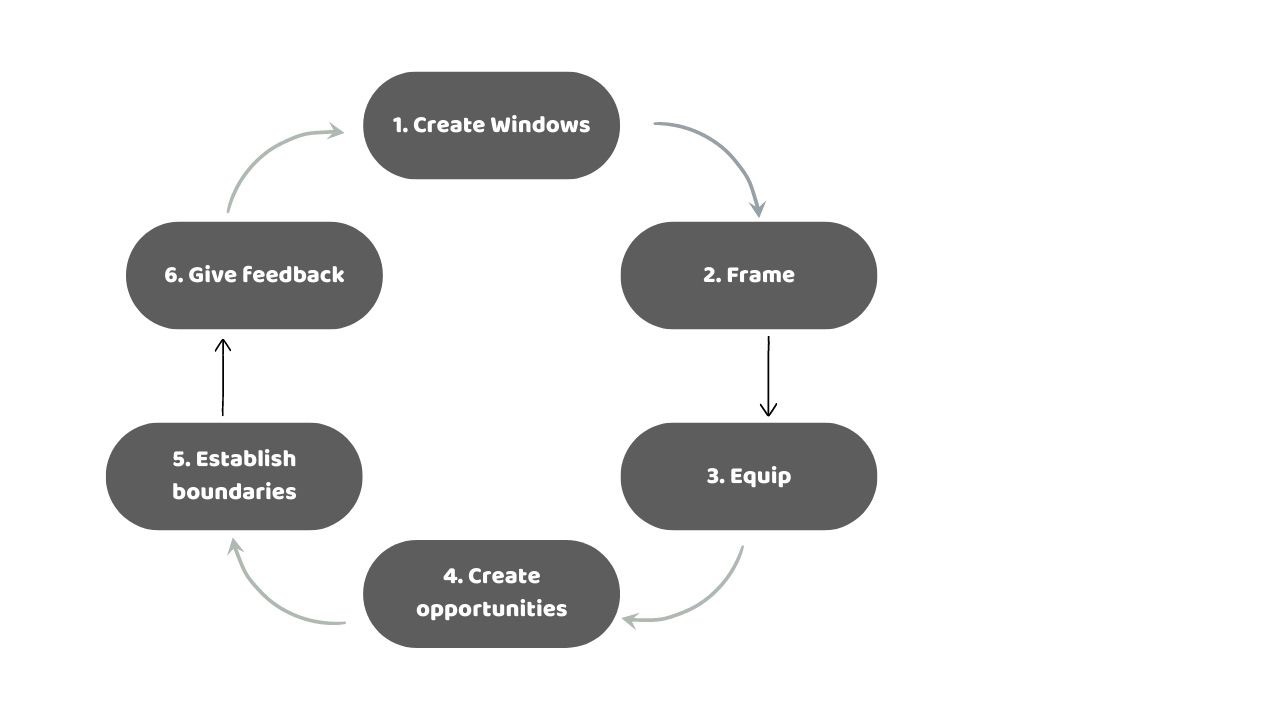
The six-stage circle

The six-stage circle: Create Windows, Frame, Equip, Create opportunities, Establish boundaries, Give Feedback, then repeat.
The six-stage circle
  1. Create windows
  2. Frame
  3. Equip
  4. Create opportunities
  5. Establish boundaries
  6. Give feedback

Finding your child’s next step using the five values of church

Children and teens don’t always like being in church. But there is so much more to church than just being present in services and groups. You can use the six-stage circle to disciple your child in any of the values of church – or anything you love about church – to help them find their next steps.

Empowered

Building Children Into the Body of Christ

Explore how to help your children find their place, purpose and contribution within the body of Christ.

Church leaders’ children often find themselves helping out at church, but this isn’t always the same as fulfilling their part of the body of Christ. There are things you can do to help your children find their own place and purpose in the church, just as any other member of the congregation.

  • Start with their passion
  • Problem-solve as a parent first
  • Treat them like a congregation member

What next?

We do hope that you have enjoyed this course and that you are already seeing the fruits in you and your family’s life. Of course, this is just a beginning, and we’d love to continue supporting you in this journey.

Tell us how it went

We’d love to hear how you got on. Your feedback helps us shape and improve what we offer for churches and for parents. One easy way to let us know what you thought is through our online community on BRF Online.

Find out more